Browser-based alternative
Use RPGMapEditor.com when you want a browser battle map maker without a desktop install.
RPGMapEditor.com is a browser-based Dungeondraft alternative for D&D and TTRPG battle maps when you want no desktop install, saved browser maps, and PNG export online. It is not a claim to replace every offline desktop authoring feature.
Use PNG export today. Universal VTT, walls, doors, and lighting export should be described as planned or not shipped unless the editor exposes those features.
RPGMapEditor.com is a Dungeondraft alternative for users who want browser-based D&D and TTRPG battle maps without a desktop install. PNG export works today; Universal VTT should be treated as planned unless shipped.
Editor access requires an account and a paid plan: the Online subscription or the €14.99 one-time Offline Edition. Compare plans.
RPGMapEditor.com is independent and is not affiliated with or endorsed by Dungeondraft.
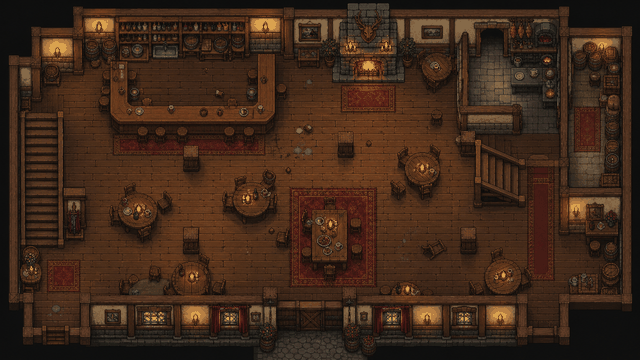
Use RPGMapEditor.com when the result needs to become an actual tabletop map: opened in the editor, edited around play, saved for later, exported as PNG, and reused when the campaign changes direction.
Use RPGMapEditor.com when you want a browser battle map maker without a desktop install.
Create practical D&D and TTRPG battle maps, save the source, and export PNG maps online.
The browser editor needs a connection. The €14.99 one-time Offline Edition runs the same editor on Windows and Linux and saves to your disk.
Do not assume Universal VTT, walls, doors, or lighting export. Use PNG today and watch the roadmap for richer handoff.
Open the editor, make one focused encounter-scale map, save it, then export once to see whether the workflow fits your table.
The same six steps whether you are building a dungeon, a wilderness ambush, or a tavern brawl. The details change by map type; the workflow does not.
Pick columns, rows, and grid scale from the encounter footprint before decorating.
Block walkable ground, walls, roads, rooms, water, caves, or outdoor edges first.
Place cover, furniture, trees, rocks, doors, hazards, and landmarks only where they help play.
Keep movement readable and add labels only when they clarify the session.
Save the editable source map to return later. Editor access requires a paid subscription.
Export a PNG for Roll20, Foundry VTT, print, projection, or campaign notes.
Pick a map size, block out the terrain, and you will have a playable layout in minutes. Save or export it when the tactical read looks right.
Use this table to decide whether the current RPGMapEditor.com workflow matches the map job before investing more prep time.
| Factor | RPGMapEditor.com | Tradeoff |
|---|---|---|
| RPGMapEditor.com is better for | Fast browser battle maps, saved encounter sources, grid readability, and PNG export | Depends on competitor; may be better for world maps, marketplaces, or offline workflows |
| Competitors can be better for | Focused tactical encounters rather than broad cartography | World/region/city maps, polished illustration, larger asset ecosystems, or mature VTT packages |
| Fair test | Build one encounter, revise it once, save it, export PNG, and test VTT alignment | Run the same test and compare output, revision time, and real table fit |
RPGMapEditor.com is built for playable encounter maps. If the job below is not yours, a different tool will serve you better.
PNG export now; richer VTT packages are not shipped The current browser workflow is saved source map plus PNG output. Choose a desktop app if native package exports are required today.
Export a PNG, import it into your usual table or VTT setup, and check grid readability before a session depends on it.
The questions DMs usually ask before starting a map like this.
It can be, if your priority is browser-based DnD battle map prep, saved source maps, grid-readable terrain and props, and PNG export. Use a deeper desktop authoring workflow when local assets or offline editing matter more.
No. RPGMapEditor focuses on browser map creation and PNG export. It does not claim native Foundry scene JSON, Roll20 dynamic lighting export, or structured wall, door, token, or lighting data.
Create one real tavern, cave, dungeon room, or boss arena, export it, align it in your VTT, then revise the source map once. That test is more useful than comparing feature lists alone.
No. The shipped workflow runs in a modern desktop browser, with account-backed saved maps and PNG export.
No. Use PNG export today and treat Universal VTT, walls, doors, and lighting export as planned unless the shipped editor exposes those options.
It is best at fast browser-based battle maps for D&D and TTRPG sessions: terrain, props, grid, saved maps, and PNG export.
Competitors can be better for world maps, regional maps, illustration-heavy cartography, marketplaces, offline editing, or native VTT package exports.
Yes. The primary workflow is browser-based and aimed at session-ready battle map creation.
Paid subscribers can save source maps. See pricing for current plans and features.
Yes. PNG export is the current output for VTTs, print, projection, and notes.
No. RPGMapEditor.com creates the map image; Roll20, Foundry, or another VTT handles tokens, walls, lights, fog, and automation.
Build the same small encounter in each tool, revise it once, export it, and test grid alignment in the VTT you actually use.
No. Use RPGMapEditor.com for battle maps and encounter scenes, not large-scale world, region, or city cartography.
No for the browser workflow. Use a desktop app only if offline editing or local asset workflows matter more.
RPG Map Editor requires paid access. See pricing for current plan features.
Open the editor, build the encounter you were planning, save it, and export a PNG when it is ready for your table.